LeetCode记录①
在LeetCode学习的记事本。

141. 判断一个链表是否含有环形结构
141.Linked List Cycle
Given a linked list, determine if it has a cycle in it.
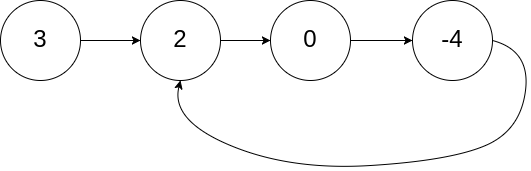
To represent a cycle in the given linked list, we use an integer
poswhich represents the position (0-indexed) in the linked list where tail connects to. Ifposis-1, then there is no cycle in the linked list.
解题思路
-
使用hash表存储访问过的节点,如果发现节点已经在表中,则表示链表含有环形结构。
-
使用快慢指针,当快指针与慢指针相遇时,表示链表中存在环形结构。
代码
java
 //141 hashSet方式
    public boolean hasCycle1(ListNode head) {
        Set<ListNode> nodeSet = new HashSet<>();
        while (head != null) {
            if (nodeSet.contains(head)) {
                return true;
            } else {
                nodeSet.add(head);
            }
            head = head.next;
        }
        return false;
    }

    //141 快慢指针方式
    public boolean hasCycle2(ListNode head) {
        ListNode slow = head;
        ListNode fast = slow;
        while (fast != null && fast.next != null) {
            slow = slow.next;
            fast = fast.next.next;
            if (slow == fast) {
                return true;
            }
        }
        return false;
    }
golang
//141 map方式 存储的K是节点地址 v可以是任意值
func hasCycle1(head *ListNode) bool {
 nodeMap := make(map[*ListNode]int)
 node := head
 for node != nil {
  if _, ok := nodeMap[node]; ok {
   return true
  } else {
   nodeMap[node] = 1
  }
  node = node.Next
 }
 return false
}

//141 快慢指针方式
func hasCycle2(head *ListNode) bool {
 slow := head
 fast := head
 for fast != nil && fast.Next != nil {
  slow = slow.Next
  fast = fast.Next.Next
  if slow == fast {
   return true
  }
 }
 return false
}
142. 找出链表中环结构的起点
142.Linked List Cycle II
Given a linked list, return the node where the cycle begins. If there is no cycle, return
null.To represent a cycle in the given linked list, we use an integer
poswhich represents the position (0-indexed) in the linked list where tail connects to. Ifposis-1, then there is no cycle in the linked list.Note: Do not modify the linked list.
解题思路
-
使用hash表存储访问过的节点,返回第一个与表中重复的节点。
-
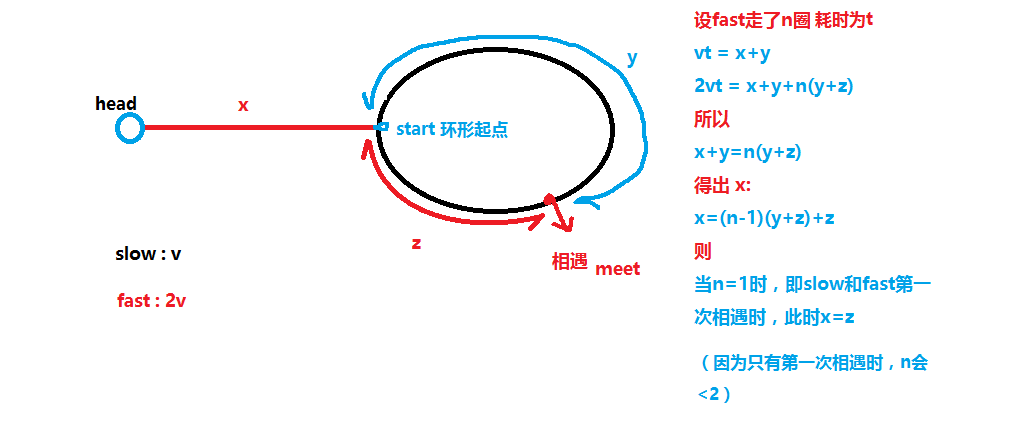
使用快慢指针,当快指针与慢指针相遇时,相遇点与环形结构起点的距离,刚好等于
head链表头节点到环形结构起点的距离。利用这一点,在第一次相遇时,让快指针再次从head开始,以与慢指针同样的速度前进,同时慢指针继续从相遇点原速前进,则接下来的相遇点即为所求的环形结构起点。- 这样说可能有些抽象,我下面画图说明:
假设有两个运动员
slow和fast,slow的速度为v,fast的速度是slow的2倍为2v,两人从head点开始通过一段长为x的直道,最后进入环形跑道做匀速运动,设两人相遇点为meet处,设环形跑道的周长C为y+z,可以得出x=kC+z,其中k为自然数。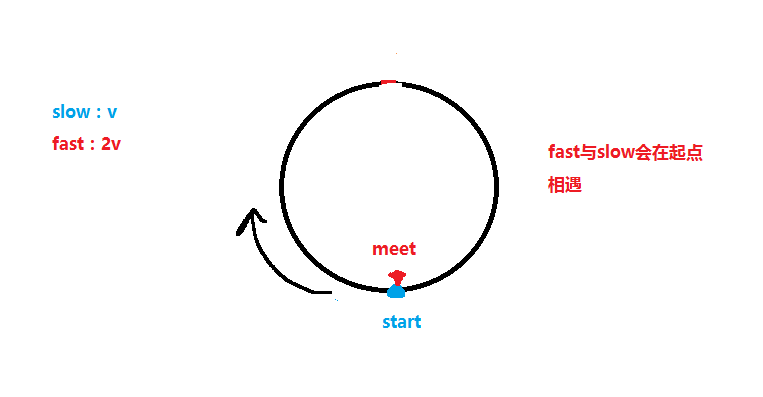
如果没有直道,相遇点就会一直是起点,也可以说明上面的推论是正确的。
代码
java
 //142 hashSet方式略

    //142 快慢指针方式
    public ListNode detectCycle(ListNode head) {
        if (head == null) {
            return null;
        }
        ListNode slow = head;
        ListNode fast = slow;
        while (true) {
            if (fast == null || fast.next == null) {
                return null;
            }
            slow = slow.next;
            fast = fast.next.next;
            if (slow == fast) {
                break;
            }
        }
        fast = head;
        while (fast != null) {
            if (fast == slow) {
                return slow;
            }
            fast = fast.next;
            slow = slow.next;
        }
        return null;
    }
golang
//142 hash表方式略

//142 快慢指针方式
func detectCycle(head *ListNode) *ListNode {
 if head == nil {
  return nil
 }
 slow := head
 fast := slow
 for {
  if fast == nil || fast.Next == nil {
   return nil
  }
  slow = slow.Next
  fast = fast.Next.Next
  if slow == fast {
   break
  }
 }
 fast = head
 for fast != nil {
  if fast == slow {
   return fast
  }
  fast = fast.Next
  slow = slow.Next
 }
 return nil
}
78. 找出一个集合的所有子集
78.Subsets
Given a set of distinct integers, nums, return all possible subsets (the power set).
Note: The solution set must not contain duplicate subsets.
Example:
Input: nums = [1,2,3]
Output:
[
  [3],
  [1],
  [2],
  [1,2,3],
  [1,3],
  [2,3],
  [1,2],
  []
]
解题思路
-
迭代,从每轮子集中寻找规律
-
结果集初始为
{},第一轮为{},{1},第二轮为{},{1},{2},{1,2},可以得出:每轮结果都是对上一轮中所有集合的扩充。对所有上轮集合都添加1个当前元素,然后把此轮得到的集合,合并到结果集。 -
将结果集命名为
allList,我在下图解释了第二轮集合的获取方式: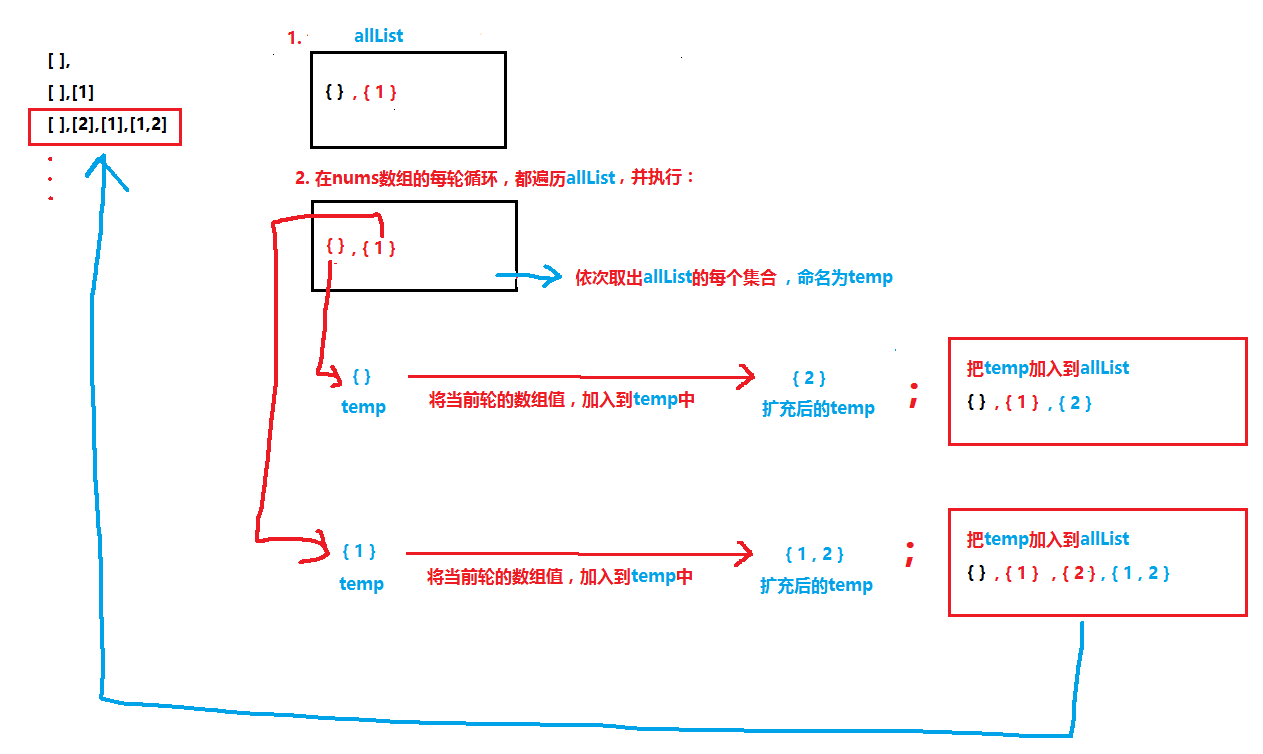
-
-
递归回溯,常用的方法,我在90题也使用了同样的方法。
代码
java
//78. 迭代方式
public List<List<Integer>> subsets(int[] nums) {
        List<List<Integer>> allList = new ArrayList<>();
        allList.add(new ArrayList<>());
        for (int value : nums) {
            for (int p = 0, size = allList.size(); p < size; p++) {
                List<Integer> temp = new LinkedList<>(allList.get(p));
                temp.add(value);
                allList.add(temp);
            }
        }
        return allList;
    }
}

 //78. 递归
    public List<List<Integer>> subsets2(int[] nums) {
        List<List<Integer>> allList = new LinkedList<>();
        backStack(nums, 0, new LinkedList<>(), allList);
        return allList;
    }

    private void backStack(int[] nums, int start, List<Integer> list, List<List<Integer>> allList) {
        allList.add(new LinkedList<>(list));
        for (int i = start; i < nums.length; i++) {
            list.add(nums[i]);
            backStack(nums, i + 1, list, allList);
            list.remove(list.size() - 1);
        }
    }

 //90. 78然后去重
    public List<List<Integer>> subsetsWithDup(int[] nums) {
        List<List<Integer>> allList = new LinkedList<>();
        //排序
        Arrays.sort(nums);
        backStack2(nums, 0, new LinkedList<>(), allList);
        return allList;
    }

    private void backStack2(int[] nums, int start, List<Integer> list, List<List<Integer>> allList) {
        allList.add(new LinkedList<>(list));
        for (int i = start; i < nums.length; i++) {
            //去重
            if (i > start && nums[i] == nums[i - 1]) {
                continue;
            }
            list.add(nums[i]);
            backStack2(nums, i + 1, list, allList);
            list.remove(list.size() - 1);
        }
    }
golang
//78 迭代方式
func subsets(nums []int) [][]int {
 all := [][]int{{}}
 for _,value := range nums{
  for _,temp := range all{
   temp = append([]int{value}, temp...)
   all = append(all, temp)
  }
 }
 return all
}

//78 递归
func subsets2(nums []int) [][]int {
 var allList [][]int
 backStack(nums,0,[]int{},&allList)
 return allList
}

func backStack(nums []int, start int, list []int, allList *[][]int) {
 *allList = append(*allList, list)
 for i := start; i < len(nums); i++ {
  list := append([]int{nums[i]}, list...)
  backStack(nums, i+1, list, allList)
  list = list[len(list)-1:]
 }
}

//90. 78然后去重
func subsetsWithDup(nums []int) [][]int {
 var allList [][]int
 sort.Ints(nums)
 backStack2(nums, 0, []int{}, &allList)
 return allList
}

func backStack2(nums []int, start int, list []int, allList *[][]int) {
 *allList = append(*allList, list)
 for i := start; i < len(nums); i++ {
        //排序
  if i > start && nums[i] == nums[i-1]{
   continue
  }
        //去重
  list := append([]int{nums[i]}, list...)
  backStack2(nums, i+1, list, allList)
  list = list[len(list)-1:]
 }
}
349. 两个数组的交集
349.Intersection of Two Arrays
Given two arrays, write a function to compute their intersection.
Example:
Input: nums1 = [4,9,5], nums2 = [9,4,9,8,4]
Output: [9,4]
这题应该是考集合的使用,使用set或者map都是可以的,第350题也大致相同。
java
    //349. Intersection of Two Arrays
    public int[] intersection(int[] nums1, int[] nums2) {
        Set<Integer> set = new HashSet<>();
        for(int num1 : nums1){
            set.add(num1);
        }
        int min = Math.min(nums1.length,nums2.length);
        int[] arr = new int[min];
        int p = 0;
        for (int num2 : nums2){
            if(set.contains(num2)){
                arr[p] = num2;
                p += 1;
                set.remove(num2);
            }
        }
        return Arrays.copyOf(arr,p);
    }

 //350. Intersection of Two Arrays II
    public int[] intersect(int[] nums1, int[] nums2) {
        Map<Integer, Integer> map = new HashMap<>();
        for (int num1 : nums1) {
            //下面这段可以用map.merge()方法表示 map.merge(num1, 1, Integer::sum);
            Integer value = map.get(num1);
            if (value != null) {
                map.put(num1, value + 1);
            } else {
                map.put(num1, 1);
            }
        }
        int min = Math.min(nums1.length, nums2.length);
        int[] arr = new int[min];
        int p = 0;
        for (int num2 : nums2) {
            Integer value = map.get(num2);
            if (value != null && value > 0) {
                arr[p] = num2;
                p += 1;
                map.put(num2, value - 1);
            }
        }
        return Arrays.copyOf(arr, p);
    }
golang
//349. Intersection of Two Arrays
func intersection(nums1 []int, nums2 []int) []int {
 aMap := make(map[int]int)
 for _, num1 := range nums1 {
  aMap[num1] = 1
 }
 var res []int
 for _, num2 := range nums2 {
  if _, ok := aMap[num2]; ok {
   res = append(res, num2)
   delete(aMap,num2)
  }
 }
 return res
}

//350. Intersection of Two Arrays II
func Intersect(nums1 []int, nums2 []int) []int {
 aMap := make(map[int]int)
 for _, num1 := range nums1 {
  //若map[int]int无此键 value为0
  if value := aMap[num1]; value > 0 {
   aMap[num1] = value + 1
  } else {
   aMap[num1] = 1
  }
 }
 var res []int
 for _, num2 := range nums2 {
  if value := aMap[num2]; value > 0 {
   res = append(res, num2)
   aMap[num2] = value - 1
  }
 }
 return res
}